“The
only possible teacher
except torture
is fine art”
Bernard Shaw, The Doctor’s Dilemma
PREAMBLE
It is not a secret: arts improve health. The
British Medical Journal recently provided
another valuable argument to support this claim. It even suggests that a diversion
of a small portion of the health budget to the arts would probably increase
the health of the population. A tempting idea indeed
However, the general public seems to be in ignorance:
the Canadian
Forum on Arts and Health found that most people are still not aware of the
benefits of the arts in relation to health and well-being
ARCANUM
" ..The one thing which
may in some degree
reconcile the cultured person with life –
scientific and artistic enjoyment..."
Eduard von Hartmann, Philosophy of the Unconscious
From
the Freudian view, arts derive from the same source as fantasies and dreams,
and have the same purpose –
to reduce tension in the soul. This applies to both creation and perception
of the art, regardless of modality –
painting, sculpture, literature, music, dance, etc. |
|
Thus, in
some respects artists are not special –
like the rest of us, they have the same narcissistic desires and fantasies,
rather shameful to share under our cultural restraints. But unlike us, artists
have a very special gift –
they are able to exhibit their fantasies in a skilful, camouflaged way, and
to attract us first with the external, formal side of their work. It traps us,
provoking a preliminary, properly aesthetic pleasure, turning our internal "censor"
off guard. And then, it enables us to enjoy our own deep prohibited fantasies
–
projected on the art –
without shame and self-blame, with revealing catharsis
How are artists able to do this? It's their
mystic secret;
it's art. 
MISSION
Piece
of pie to the artists,
Peace of mind to the rest of us
THEMES
Besides
the solo exhibitions of contemporary fine art, the gallery offers annual thematic
shows:
•
SPRING. Acknowledging Freudian Psychoanalysis as the most profound
metaphor ever offered for the comprehension of human behaviour, spring exhibition
Ladies
- First presents
artists' free associations on Unconscious Drives, Basic Instincts, Inter-Personal
Conflicts, Libido, Love, Dreams, etc. 
• SUMMER. Recognizing Therapeutic Recreation as an effective
treatment modality, summer exhibit Coming About is all about sailing
– one of those activities that make us feel better mentally and emotionally
without cheap Prozac or expensive therapy
• FALL is not an easy season for many: back-to-work depressions, psychotic
de-compensations, increased suicides... Perhaps not surprisingly, October is
the International Mental Illness Awareness Month. Exhibition Déjà
Vu
is the gallery's post-season retrospective
• WINTER – time of falling stars, realisation of mortality and philosophical
reflection on life. In a broader view, all human existence is nothing but Narrative,
anyway. So far, "Fairytale" is a generic icon for the winter show
"From the Gallery Collection"
HERITAGE
Back in the 19th century, a tiny walking lane
was designed to connect the Court House with the main street of downtown Bracebridge.
Perhaps
not surprisingly it was named "Chancery," thinking of Chancery Lane
in London, UK
–
the "lawyers district"
Today the Court House is still operational and
lawyers' offices continue to function on and around Chancery Lane. Besides,
word "chancery" possesses connotations that lead somewhat beyond just
a Law, considering the initial Chancery Court of 15th–17th
centuries in England and Wales, which specifically dealt with behavioural issues
from the perspective of the human sense of Fairness and Equity –
concepts of the Conscious. Thus, we were both historically and linguistically
pre-determined to preserve this "chancery" touch while choosing a
name for the gallery owned and curated by two psychology doctors on the Chancery
Lane
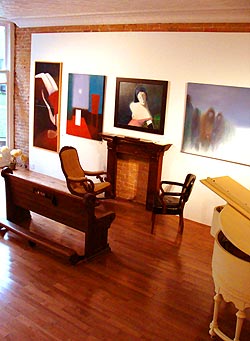
With respect to the spirit of the 19th century
building in historical Bracebridge, it felt like an obligation to throw down
its convenient modern "drop ceiling" in order to expose the charm
of its original metal tiles underneath. Old masonry containing traces of the
building's story on its bricks was also appealing for emancipation from layers
of stucco, paint, drywall and paper. Pieces of antique furniture of the period
were re-introduced on the floor
At different points of the past centuries, various enterprises were located
in this house, such as a Tobacconist Shop, Book Store, and
the famous Shelly Bistro. Now here is a Gallery. Yet, with
the temptation of keeping with historical continuation in the old town, there
is an attempt to recreate an allusion to the past. Thus in the gallery you still
may buy a book, a cigar, or some fine chocolate.
Understandably, though, here you will only find items  associated with Art & Psychology and linked
to the decadence of the bohemian Montmartre at the turn of the previous centuries
associated with Art & Psychology and linked
to the decadence of the bohemian Montmartre at the turn of the previous centuries
The town’s legend offers that several
ghosts inhabit the area. Moreover, the popular Bracebridge Ghost
Tour that starts at the Inn-at-the-Falls and continues beside the Court
House through Chancery Lane  to the main street. Thus, the gallery happens
to occupy a recognised "haunted house." Without going into details
of believers and related experiences, the gallery reserves a shelf for books
on the topic and opens its doors to Ghost Tour visitors, even after hours. A
"Ghost Reading" takes place in the gallery on the Halloween Night
and
to the main street. Thus, the gallery happens
to occupy a recognised "haunted house." Without going into details
of believers and related experiences, the gallery reserves a shelf for books
on the topic and opens its doors to Ghost Tour visitors, even after hours. A
"Ghost Reading" takes place in the gallery on the Halloween Night
and
PHILANTHROPY
•
In the gallery,
free of charge, school and university instructors conduct their art classes
•
Writers give new book presentations
•
Musicians
gather an audience for a concert
•
Young
artists’ multi-media festival Ardour
Eruption is an annual charitable project of the gallery
• On occasion, the gallery selects and brings to Muskoka international
highlights from Toronto Art Expo
• Multi-media
Sailing Festival
along
with Chancery
Regatta
in July is
also a philanthropic action of the gallery for support of "green"
philosophy and clean waters of Muskoka
•
Another "green"
initiative – annual celebrarion of the Earh
Hour on the last saturday of March
•
For the public,
the gallery is accessible admission free, including "by appointment"
arrangements
•
Through its web site, the gallery promotes local businesses, attractions, and
events – over fifty links are listed on the LOCATION
page without expectation of "link exchange"
•
A
portion of the revenue from sales of certain
artworks is assigned for the animal shelter of Bracebridge as our lepta
for those who happen, in a sense, to be even more vulnerable than artists. All
empty bottles accumulated in the gallery are also donated to the animal shelter
•
The
gallery does not charge artists for exhibiting their works – only
if an art is sold, the gallery retains a commission
•
Occasionally, for "artist-in-crisis" a consultation is offered pro-bono
in the gallery-affiliated psychology office on premises 
SPONSORS
Some people
believe that Chancery Art Gallery is a “public gallery”
funded by the municipality… Although it might be a nice compliment, but
in fact, it is a private independent commercial gallery that operates on its
own without external subsidy. Nevertheless, for support of the charitable
projects listed above, outside contributions will not be declined without
consideration
FELLOWSHIP
Owner and director of Chancery Art Gallery,
Lena Kolobow
holds a doctoral degree in psychology and has years of University teaching,
academic research and clinical practice (including art therapy) in
Russia, USA and Canada
GALLERY
IMAGES
According to a prominent Toronto
The BAY STREET BULL magazine
(Luxury Travel, Golf, Automobile, Restaurants,
Fashion and Book Reviews)
Muskoka
Edition 2011, pp. 22-25
"...
This tiny, out-of-the way gallery
may be Bracebridge's best kept secret
and one of the best places to enjoy great art
in Ontario"

ANNUAL
EVENTS & GATHERINGS |
|